


Crisis Management Module
Humanitarian Leadership Academy
The Challenge
The Humanitarian Leadership Academy needed to deliver crisis management training to learners operating in regions where face-to-face delivery was either politically restricted or unsafe due to local conditions. The subject matter was complex, sensitive, and critically important, yet the subject matter expert had limited experience working within digital learning environments.
The challenge extended beyond simply converting classroom materials into eLearning. The original content was extensive, academically dense, and emotionally demanding for learners already working in high-pressure humanitarian contexts. A direct translation into digital format risked overwhelming learners and reducing engagement with vital information.
Systems Thinking & Design Approach
Rather than treating the project as a traditional content conversion exercise, I approached it as a behavioural and experiential design challenge.
Working closely with the SME, I led a collaborative mentoring process to help adapt specialist knowledge into a format suitable for self-directed digital learning. Through workshops, iterative reviews, and learner-focused restructuring, we identified opportunities to reduce cognitive overload while preserving the integrity of the material.
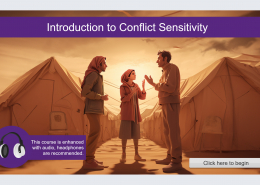
To create a more emotionally engaging and accessible experience, I reframed large sections of informational content into narrative-driven formats, including:
- scripted scenario storytelling
- simulated discussion formats
- “podcast-style” conversational learning
- visual storytelling and illustration
- guided reflective interactions
This approach transformed dense informational content into a more human and relatable learning experience.
The module was developed using:
- Articulate Storyline
- Adobe Creative Suite
- AI-assisted voice workflows
- traditional illustration and visual development techniques
The visual direction intentionally balanced professional corporate clarity with a humanitarian-centred aesthetic, ensuring the experience felt credible, empathetic, and globally accessible.
Innovation & AI Integration
As part of the project, I explored the responsible use of emerging AI tools within humanitarian learning environments.
AI-assisted workflows were used selectively to support:
- rapid ideation
- voice production
- visual exploration
- content prototyping
However, human oversight, editorial judgement, and ethical considerations remained central throughout the process.
Alongside the build itself, I collaborated with a wider workshop and governance group focused on the adoption, risks, and responsible implementation of AI within learning design. This work contributed toward the development of internal guidance, processes, and practical recommendations for future AI-enabled training initiatives.
My Role
I led the project from concept through to final delivery, including:
- learning experience design
- instructional strategy
- scriptwriting
- visual development and illustration
- Storyline development
- AI workflow experimentation
- stakeholder management
- SME mentoring
- multimedia production
- project coordination
Outcome
The final experience successfully transformed highly complex humanitarian training content into a more engaging, accessible, and emotionally resonant digital learning experience suitable for geographically distributed learners operating in challenging environments.
The project also helped establish practical foundations for future AI-supported learning workflows within the organisation while reinforcing the importance of human-centred design, ethical oversight, and narrative engagement in digital humanitarian training.
 austen shand
 Austen Shand
 austen shand