


Cash & Voucher Assistance (CVA) Learning Series
Humanitarian Leadership Academy / CaLP
The Challenge
Cash and Voucher Assistance (CVA) is a form of humanitarian aid that enables people affected by crisis to access goods and services based on their own priorities and immediate needs, rather than receiving predefined material assistance such as food or supplies.
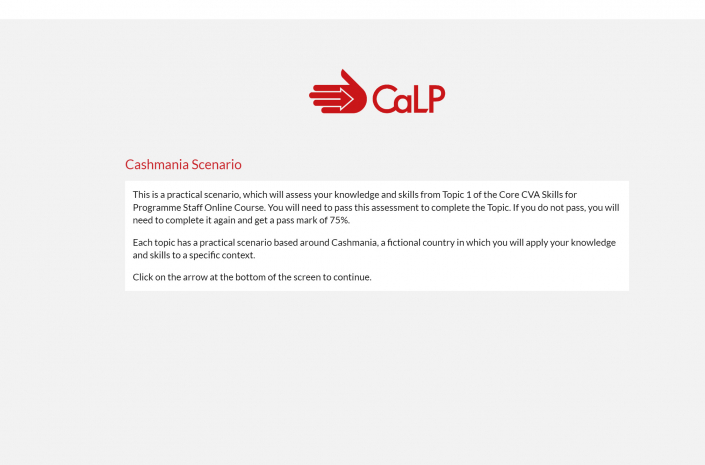
As part of a consultancy project for Oxfam’s Cash and Voucher Assistance Programme (CaLP), the challenge was to create a series of digital learning experiences capable of supporting both technical and non-technical humanitarian audiences operating across diverse global contexts.
The subject matter itself was operationally complex, policy-heavy, and often difficult to contextualise for learners unfamiliar with humanitarian cash assistance systems. The experience needed to remain globally accessible, emotionally engaging, and culturally sensitive while still delivering clear technical understanding.
Systems Thinking & Design Approach
Originally scoped as a Storyline-based solution, the project direction shifted during development following client discussions around sustainability, internal capability, and long-term ownership.
The client required a platform that could be maintained internally without reliance on proprietary Storyline licensing or specialist in-house development skills. In response, I adapted the design and development approach to utilise Adapt, enabling greater future flexibility and maintainability for the organisation.
Rather than relying on static informational content, I structured the learning experience around:
- guided branching scenarios
- narrative-led decision making
- “safe space” reflective interactions
- progressive learner support
- scenario-based contextual learning
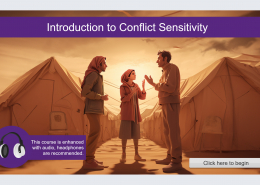
To support learner engagement, I designed the experience using a highly visual comic-book-inspired storytelling approach centred around a recurring character narrative following Lina, whose experiences connected learners across multiple modules within the wider training programme.
The intention was to create an emotionally grounded and approachable experience capable of making complex humanitarian systems feel human, relatable, and operationally relevant.
Narrative & Interaction Design
The learning experience used short-form branching interactions and practical scenario design to help learners explore the real-world implications of Cash and Voucher Assistance programmes in humanitarian settings.
Rather than overwhelming learners with policy-heavy instructional content, the experience focused on:
- contextual storytelling
- guided learner reflection
- consequence-based decisions
- conversational pacing
- visual empathy and accessibility
The branching scenario structure allowed learners to safely explore decisions and outcomes while building confidence in operational understanding.
The comic-inspired visual approach also helped reduce intimidation around complex humanitarian terminology while maintaining professional credibility and emotional resonance.
Visual Direction & Inclusive Character Design
A significant part of the project involved the creation of bespoke artwork, environments, and character systems to support the broader narrative experience.
The visual direction intentionally avoided generic corporate humanitarian imagery in favour of a more human-centred illustrated style that felt approachable, globally representative, and emotionally authentic.
Particular attention was given to the representation of:
- disability
- race
- gender
- cultural diversity
The goal was to ensure representation felt genuinely integrated into the narrative world rather than performative or tokenistic.
The recurring visual identity across the CaLP series also helped create continuity between modules while strengthening learner recognition and engagement throughout the wider programme.
Tools & Production Pipeline
The project was developed using a handcrafted illustration and digital learning workflow focused on flexibility, accessibility, and scalable visual storytelling.
Core Production Tools
- Adapt
- Elucidat
- Adobe Photoshop
- Adobe Illustrator
- Procreate on iPad Pro
These tools supported:
- scenario-based learning design
- bespoke illustration workflows
- comic-inspired visual storytelling
- interactive branching experiences
- responsive learning development
- scalable humanitarian training delivery
All artwork, illustrations, scenarios, and visual storytelling elements were manually designed and produced as part of a fully handcrafted creative workflow.
The overall production approach combined traditional illustration methods with digital learning systems design to create a visually distinctive and globally accessible learner experience.
My Role
I led the project from concept through to delivery, including:
- instructional and interaction design
- storyboard development
- scenario creation
- narrative structure
- character and environment illustration
- branching learning design
- platform adaptation strategy
- stakeholder collaboration
- course development and build
- visual direction
I also worked closely with development teams to adapt and replicate bespoke interaction approaches within the technical constraints of the chosen platform.
Outcome
The final learning series successfully transformed complex humanitarian operational content into an engaging, narrative-driven digital learning experience suitable for diverse global audiences across the humanitarian sector.
The project demonstrated how visual storytelling, inclusive character design, and interactive narrative systems can improve accessibility and engagement around highly technical humanitarian subject matter.
The work received industry recognition at the Learning Technologies Awards 2023, winning Silver for Excellence in the Design of Learning Content – Public & Non-Profit / NGO Sector.
 austen shand
 Austen Shand
 Austen Shand