

Introduction to Proposal & Report Writing
Humanitarian Operations Programme (HOP Fundamentals)
The Challenge
Proposal and report writing are essential skills within humanitarian and development organisations, yet for many early-career professionals the processes can feel intimidating, procedural, and disconnected from the realities of operational work.
This standalone module, developed as part of the HOP Fundamentals suite, was designed to provide learners with a foundational understanding of proposal and report writing within humanitarian and development contexts.
The course targeted:
- individuals beginning careers within the humanitarian sector
- professionals transitioning from development into humanitarian work
- learners without formal humanitarian training
- practitioners seeking to refresh their operational knowledge
The core challenge was transforming traditionally dry, process-heavy content into an experience that felt engaging, practical, and emotionally relatable without compromising professional credibility.
Systems Thinking & Design Approach
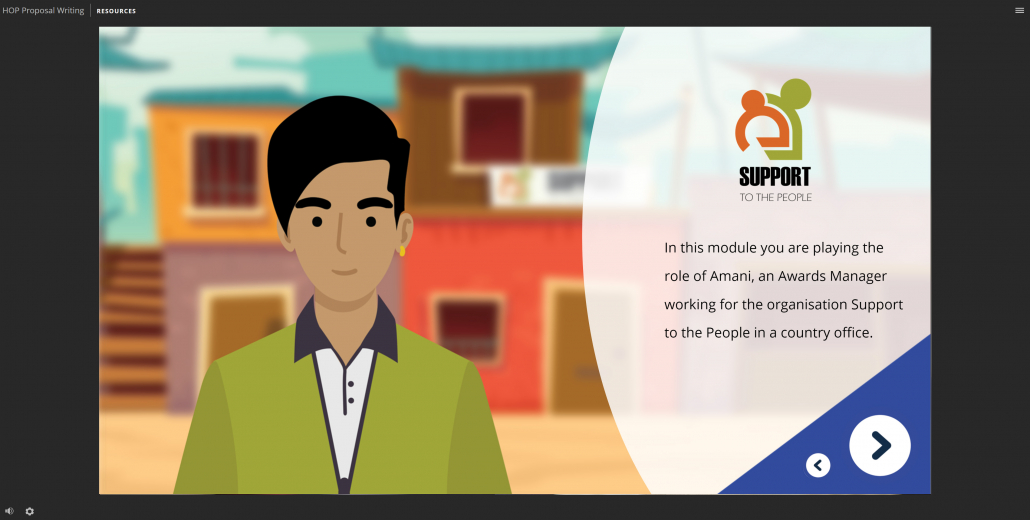
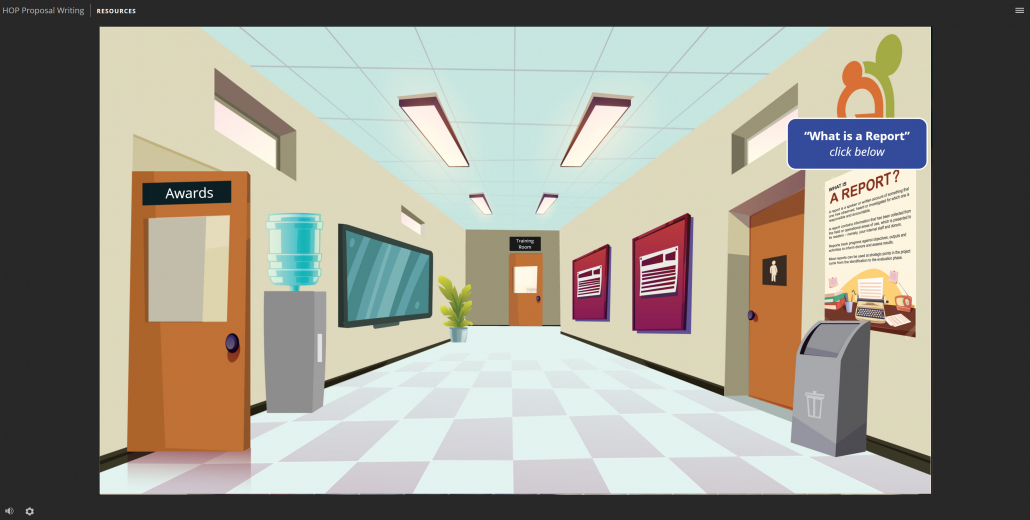
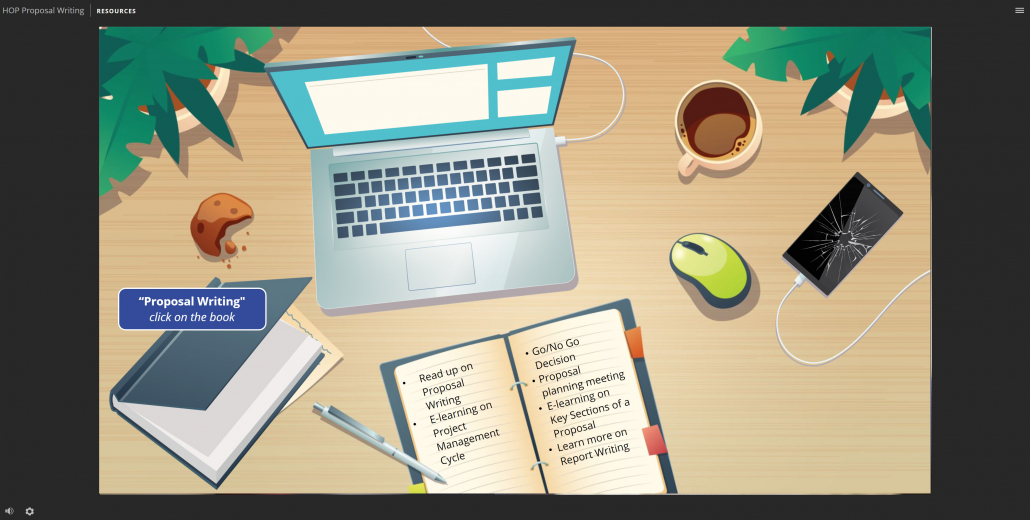
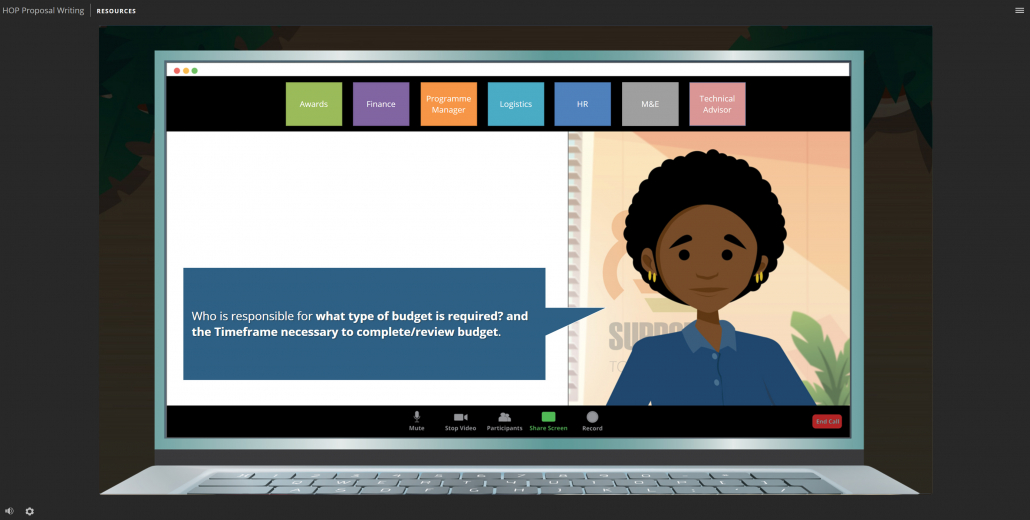
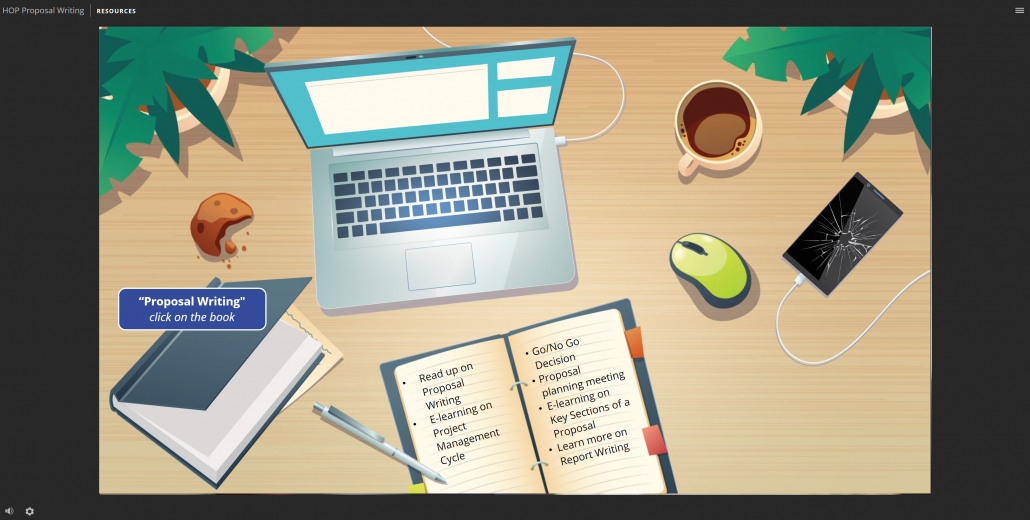
Rather than approaching the module as a conventional information-led eLearning course, I designed the experience around a “day in the life” simulation model.
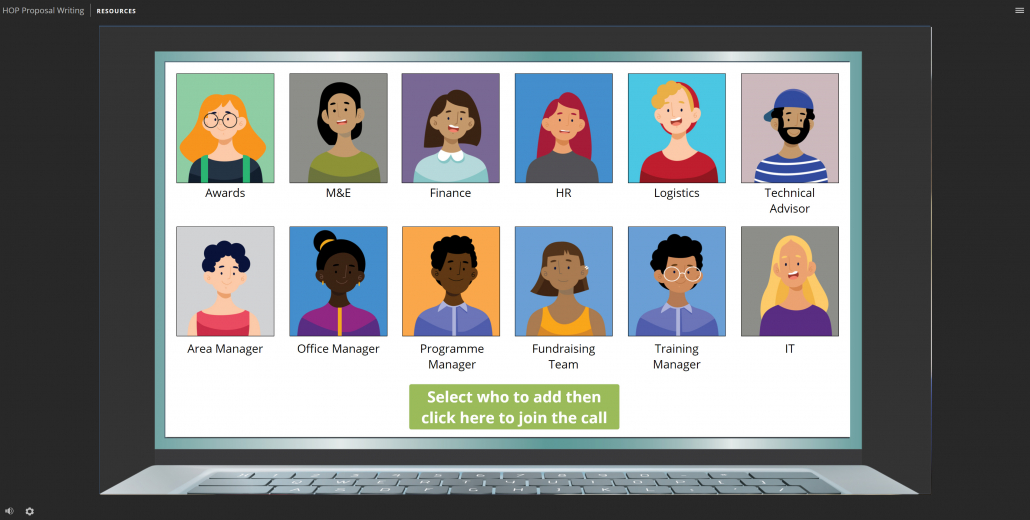
The learner followed a fictional humanitarian worker throughout a typical working day, navigating:
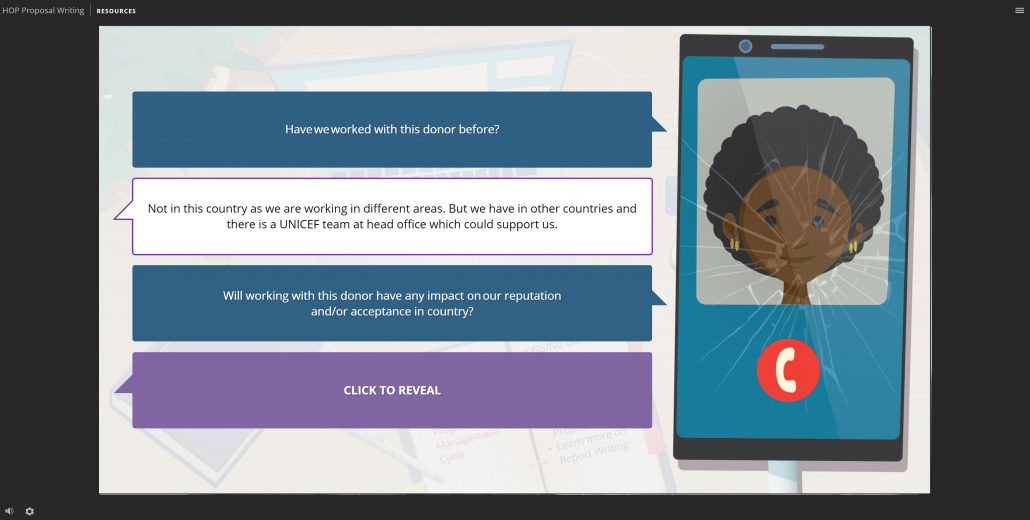
- incoming calls
- peer collaboration
- operational tasks
- mentoring conversations
- reporting responsibilities
- proposal development decisions
This structure allowed learners to contextualise proposal and report writing within the wider realities of humanitarian work rather than viewing it as an isolated administrative task.
The experience intentionally moved away from passive “next click” instructional design in favour of:
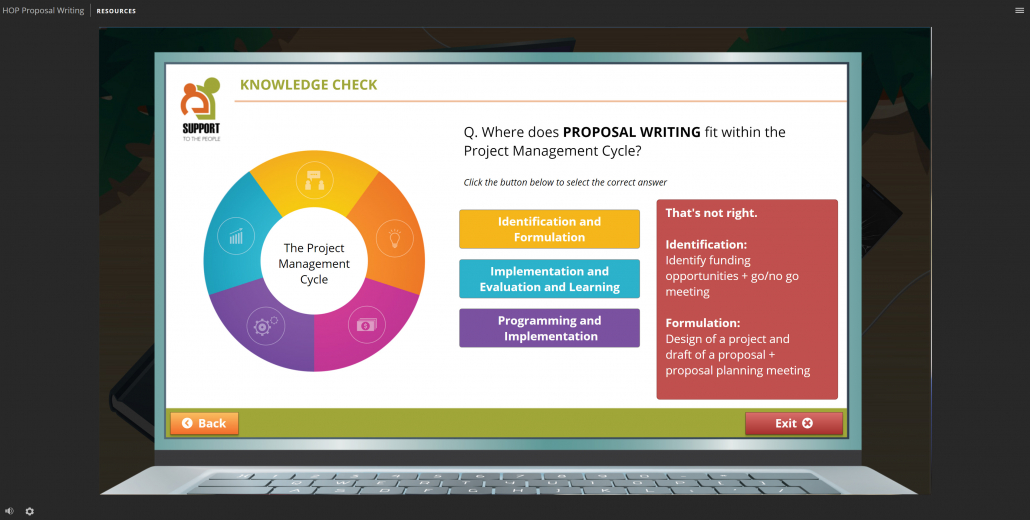
- contextual interactions
- narrative-led progression
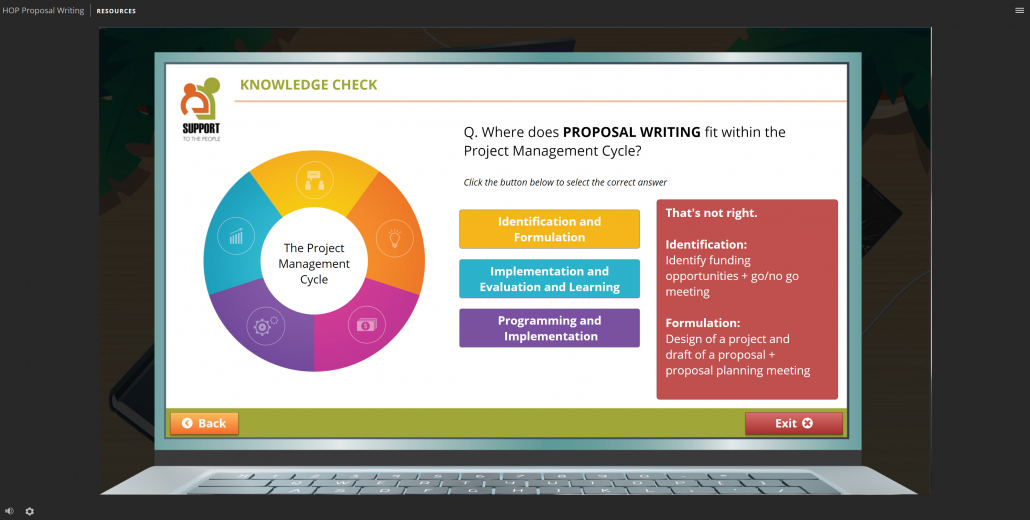
- scenario-based learning
- conversational pacing
- guided decision-making
The goal was to create a learning experience that felt operationally authentic, human-centred, and practically relevant.
Narrative & Interaction Design
The simulation structure was designed to create a sense of movement, routine, and professional immersion.
Throughout the experience, learners interacted with:
- colleagues
- mentors
- operational stakeholders
- workplace communication systems
The branching interactions encouraged learners to think critically about:
- communication clarity
- information prioritisation
- audience awareness
- operational context
- professional tone
By embedding learning into realistic workplace interactions, the experience helped learners build confidence gradually while reducing the cognitive fatigue often associated with procedural training.
Visual Direction
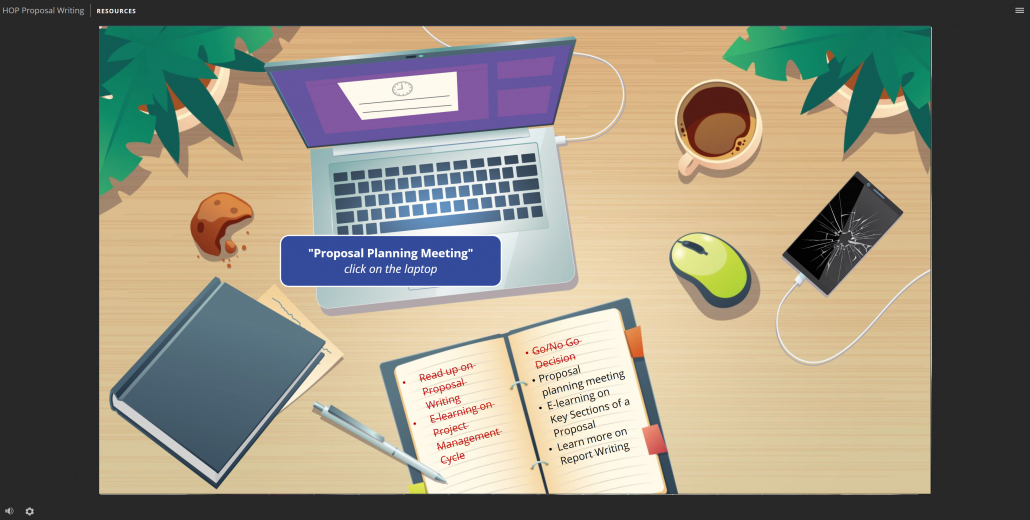
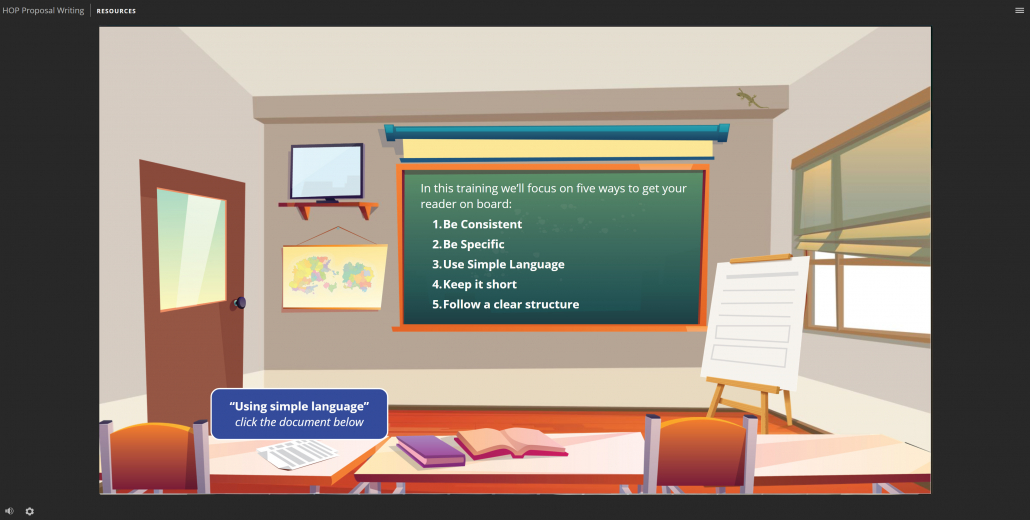
The visual approach focused on creating a warm, accessible, and grounded professional environment that reflected the realities of humanitarian office culture without feeling overly corporate or institutional.
Bespoke illustration and environmental storytelling were used throughout the module to:
- support immersion
- reinforce narrative pacing
- humanise technical content
- create visual continuity across interactions
The overall design intentionally balanced clarity and professionalism with a more approachable and conversational tone.
Tools & Production Pipeline
The module was developed using a handcrafted visual storytelling and interactive learning workflow.
Core Production Tools
- Articulate Storyline
- Adobe Photoshop
- Adobe Illustrator
These tools supported:
- interactive scenario design
- bespoke illustration workflows
- narrative learning interactions
- workplace simulation design
- visual storytelling
- responsive eLearning development
All artwork, interactions, scenarios, and visual assets were manually designed and produced without the use of AI-assisted workflows or generated audio.
The production approach focused on combining instructional structure with immersive scenario design to create a more engaging and operationally relevant learner experience.
My Role
I led the project from concept through to delivery, including:
- learning experience design
- scenario development
- narrative structure
- Storyline development
- visual direction
- illustration and artwork production
- interaction design
- learner flow design
Outcome
The final experience successfully transformed process-heavy humanitarian training content into a more engaging, scenario-driven digital learning experience that supported both knowledge acquisition and practical workplace contextualisation.
By grounding procedural learning within realistic human interactions and operational scenarios, the course demonstrated how narrative-led simulation design can significantly improve learner engagement within professional training environments.
You can find the course HERE

 austen shand
 Austen Shand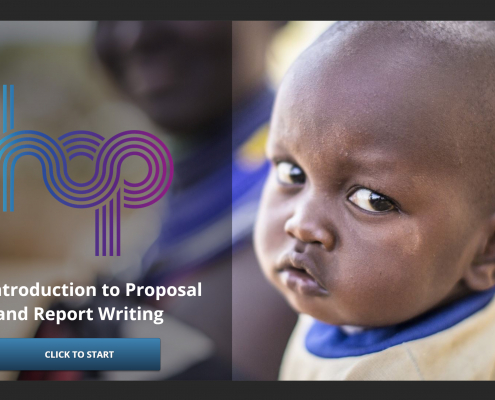
Crisis Management Module
Humanitarian Leadership Academy
The Challenge
The Humanitarian Leadership Academy needed to deliver crisis management training to learners operating in regions where face-to-face delivery was either politically restricted or unsafe due to local conditions. The subject matter was complex, sensitive, and critically important, yet the subject matter expert had limited experience working within digital learning environments.
The challenge extended beyond simply converting classroom materials into eLearning. The original content was extensive, academically dense, and emotionally demanding for learners already working in high-pressure humanitarian contexts. A direct translation into digital format risked overwhelming learners and reducing engagement with vital information.
Systems Thinking & Design Approach
Rather than treating the project as a traditional content conversion exercise, I approached it as a behavioural and experiential design challenge.
Working closely with the SME, I led a collaborative mentoring process to help adapt specialist knowledge into a format suitable for self-directed digital learning. Through workshops, iterative reviews, and learner-focused restructuring, we identified opportunities to reduce cognitive overload while preserving the integrity of the material.
To create a more emotionally engaging and accessible experience, I reframed large sections of informational content into narrative-driven formats, including:
- scripted scenario storytelling
- simulated discussion formats
- “podcast-style” conversational learning
- visual storytelling and illustration
- guided reflective interactions
This approach transformed dense informational content into a more human and relatable learning experience.
The module was developed using:
- Articulate Storyline
- Adobe Creative Suite
- AI-assisted voice workflows
- traditional illustration and visual development techniques
The visual direction intentionally balanced professional corporate clarity with a humanitarian-centred aesthetic, ensuring the experience felt credible, empathetic, and globally accessible.
Innovation & AI Integration
As part of the project, I explored the responsible use of emerging AI tools within humanitarian learning environments.
AI-assisted workflows were used selectively to support:
- rapid ideation
- voice production
- visual exploration
- content prototyping
However, human oversight, editorial judgement, and ethical considerations remained central throughout the process.
Alongside the build itself, I collaborated with a wider workshop and governance group focused on the adoption, risks, and responsible implementation of AI within learning design. This work contributed toward the development of internal guidance, processes, and practical recommendations for future AI-enabled training initiatives.
My Role
I led the project from concept through to final delivery, including:
- learning experience design
- instructional strategy
- scriptwriting
- visual development and illustration
- Storyline development
- AI workflow experimentation
- stakeholder management
- SME mentoring
- multimedia production
- project coordination
Outcome
The final experience successfully transformed highly complex humanitarian training content into a more engaging, accessible, and emotionally resonant digital learning experience suitable for geographically distributed learners operating in challenging environments.
The project also helped establish practical foundations for future AI-supported learning workflows within the organisation while reinforcing the importance of human-centred design, ethical oversight, and narrative engagement in digital humanitarian training.

 austen shand
 Austen Shand
 Austen Shand